Sloped driveways are common across Hertfordshire. The Chiltern Hills chalk hills creates sharp elevation changes between the road and properties along its length from Shenley through St Albans, Wheathampstead, and onward to the countryside above Hitchin. The Hertfordshire clay hills between Radlett and Harpenden produce rolling terrain where driveways frequently slope, curve, or both. And many Hertfordshire villages sit on hillsides where the road is at one level and the property is at another.
The question is not whether gates can be installed on a sloped driveway. They can. The question is which type of gate, which motor configuration, and which hinge geometry work on your specific gradient. Getting this right requires an installer who has worked on sloped sites before, because the engineering is different from a flat driveway and the consequences of getting it wrong are expensive to fix.
Why Slope Creates Problems for Swing Gates
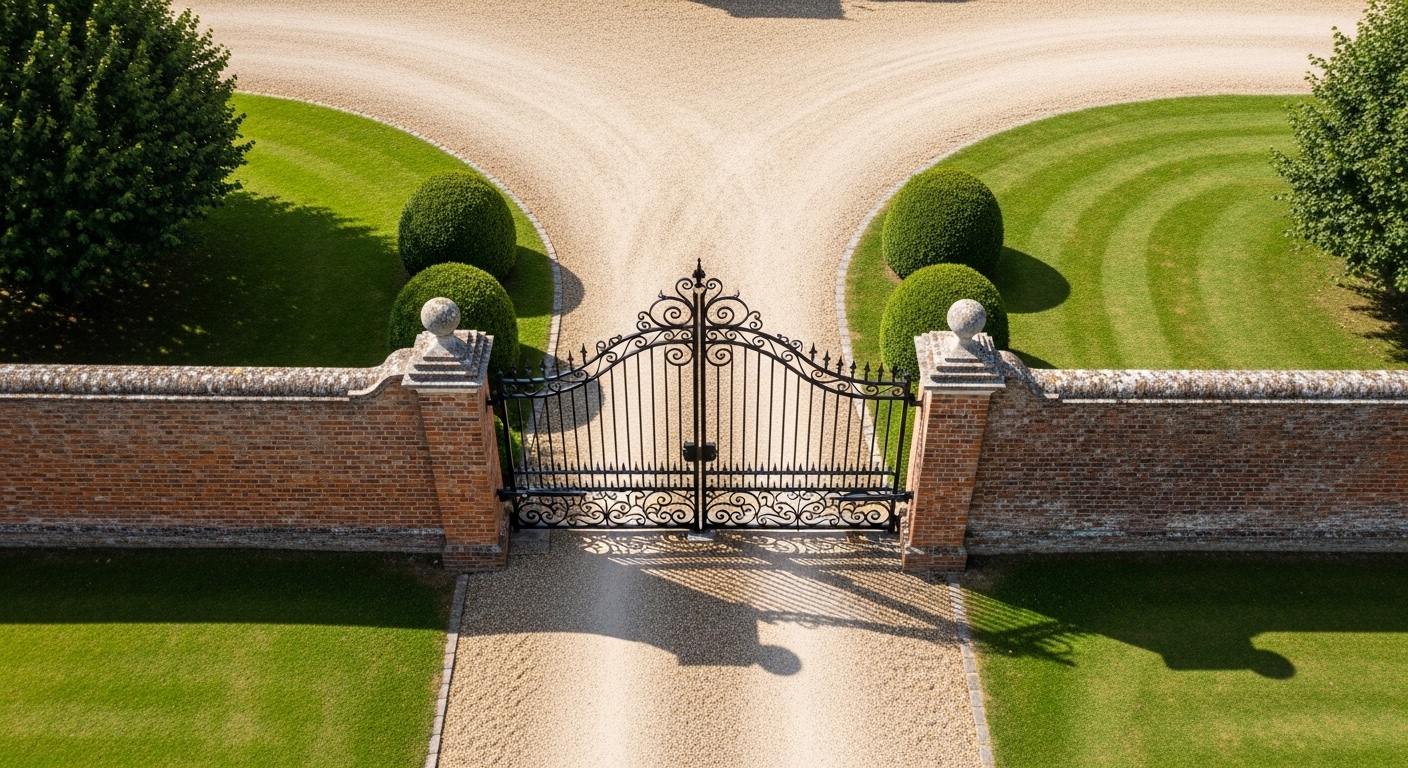
A swing gate opens in an arc. The bottom edge of the gate leaf traces a circular path as it swings from closed to open. On a flat driveway, this path stays at a consistent height above the ground and the clearance between the gate bottom and the surface is uniform throughout the arc. On a driveway that slopes, the ground surface rises or falls relative to the arc path, and the clearance changes.
If the driveway slopes downward from the road toward the house (the most common configuration in Hertfordshire, where properties sit below the road level), the ground drops away as the gate opens inward. The gate leaf clears the ground easily at the start of its travel but may have excessive clearance at the fully open position, which looks odd and compromises security at the bottom of the gate.
If the driveway slopes upward from the road (less common, but found on properties above road level on the Chiltern Hills), the ground rises into the arc path as the gate opens. The gate leaf may scrape or jam partway through its travel, and a standard motor will stall or reverse when it meets the resistance. This is the more problematic configuration and the one where a flat-driveway specification will fail.
No Cost, No Obligation
Need gate quotes for your Hertfordshire property?
Submit your details and we connect you with up to three screened Hertfordshire gate installers. Completely free.
Solutions for Swing Gates on Slopes
The first solution is articulated hinges. These are hinges with a built-in pivot that lifts the gate leaf as it opens, compensating for the rising ground surface. The lift angle is set during installation to match the driveway gradient. Articulated hinges handle gradients up to approximately 10 degrees (about 1 in 6) and are the standard solution for moderate slopes across Hertfordshire.
The second solution is to adjust the motor force and travel settings to account for the gradient. A gate opening uphill requires more motor torque than the same gate on a flat surface. Underground motors with higher torque ratings, or ram-arm motors with adjustable force settings, can be tuned to drive the gate through its arc on a slope. This works in combination with articulated hinges on steeper gradients.
The third solution, for steep slopes where swing gates are impractical regardless of hinge engineering, is to switch to a sliding gate. This is the most common outcome on Hertfordshire driveways with gradients above 10 degrees.
Why Sliding Gates Handle Slopes Better
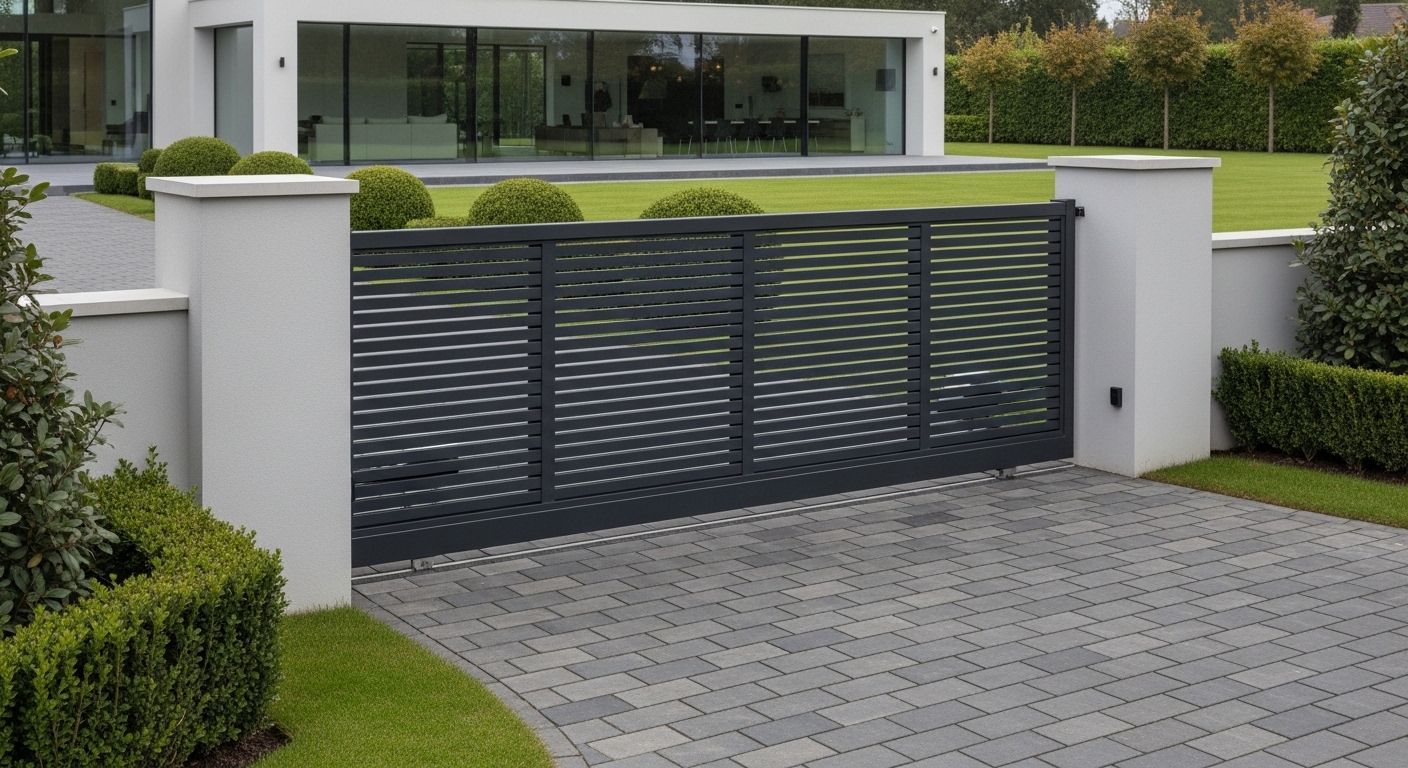
A sliding gate moves horizontally along the boundary rather than swinging through an arc. It does not need to clear a changing ground surface because it travels parallel to the boundary, not perpendicular to the driveway. The track or cantilever rail is installed level along the boundary, and the gate slides along it regardless of what the driveway surface is doing in the perpendicular direction.
Ground-track systems require the track itself to be level, which may mean building up the track foundation on the lower side of a sloped boundary. This is standard groundwork and adds modest cost. Cantilever systems, which suspend the gate from an elevated rail rather than running it on a ground track, eliminate the ground-level constraint entirely and are the preferred configuration for the steepest Hertfordshire sites.
The trade-off with sliding gates is the run-back space requirement. The gate needs a clear boundary to one side at least as wide as the gate leaf plus approximately 500mm. On sloped sites, this boundary run needs to be level as well, which may require retaining work on sites where the boundary follows the slope of the land. Your installer will assess whether the run-back can be achieved within the existing boundary or whether modification is needed.
What Gradient Can Each System Handle
Swing gates with standard hinges and standard motors work on gradients up to about 3 degrees (approximately 1 in 20). This covers driveways that have a gentle slope that most people would not think of as sloped.
Swing gates with articulated hinges and uprated motors handle gradients from 3 to 10 degrees (approximately 1 in 20 to 1 in 6). This covers the majority of noticeably sloped driveways in Hertfordshire, including most properties on the Chiltern Hills ridge and the rural Hertfordshire countrysideen hillsides.
Above 10 degrees, sliding gates with a cantilever system are the reliable solution. Properties with very steep driveways, which are found on the scarp face of the Chiltern Hills and on some of the steeper Hertfordshire lanes, fall into this category. There is no practical upper gradient limit for a cantilever sliding gate because the gate travel is independent of the driveway surface.
How an Installer Assesses a Sloped Site
The site survey on a sloped driveway involves measuring the gradient at the gate line, the gradient across the full swing arc (for swing gates), the run-back availability and level (for sliding gates), the soil type (which affects foundation specification), and the available power supply position relative to the motor location. A good installer photographs the driveway from multiple angles and takes measurements with a spirit level or digital inclinometer rather than estimating by eye.
The assessment should result in a clear recommendation for gate type, motor configuration, and any additional groundwork required, along with a written quote that itemises these elements separately. If an installer quotes for a standard swing gate installation without mentioning the gradient or visiting the site, they are not accounting for the slope and the installation is likely to have problems.
The Cost Difference on a Sloped Site
Articulated hinges add £200 to £500 to a swing gate installation. Uprated motors or underground units with higher torque ratings may add £300 to £800 depending on the brand and model. A cantilever sliding gate system typically costs £800 to £2,500 more than a standard ground-track installation due to the heavier framework and the more complex foundation. These are real cost additions, but they are substantially less than the cost of installing a standard system, discovering that it does not work on the slope, and then modifying or replacing it.
Finding an Installer Who Knows Sloped Sites
Experience with sloped driveways is not universal among gate installers. An installer who works primarily on flat suburban driveways in North Hertfordshire may not have encountered the gradient challenges that are routine on the Chiltern Hills or in the rural Hertfordshire countryside. When we match you with installers, we account for site conditions including gradient, and connect you with firms that have handled sloped installations in your part of Hertfordshire.
Submit your enquiry with your postcode and a note about the driveway slope. Photographs showing the gradient from the road are helpful. We will match you with up to three vetted Hertfordshire gate specialists who have the experience to get the specification right for your site.