Hertfordshire has one of the densest concentrations of period residential properties in England. The medieval streets of St Albans and Wheathampstead, the Georgian and Victorian terraces of Harpenden, the Edwardian suburbs of St Albans and Radlett, and the rural Hertfordshire countrysideen farmsteads and period farmhouses scattered across the countryside from Berkhamsted to Harpenden all create contexts where a gate needs to do more than close off a driveway. It needs to sit within the visual language of the building and the street without drawing attention to itself as something new.
Getting this right requires understanding what the property is saying architecturally and designing a gate that responds to it. Getting it wrong results in a gate that jars with the house, annoys the neighbours, and in conservation areas may not pass planning scrutiny at all. This guide covers the design principles, material choices, and practical considerations for gates on older Hertfordshire houses.
The First Principle is to Read the Building
Before thinking about gate styles, look at the house and the boundary as they are now. What materials are used on the front elevation? Red brick, ragstone, render, tile-hanging, timber frame, flint? What is the existing boundary treatment? A brick wall, a hedge, iron railings, post and rail, close board fencing? What is the scale of the entrance relative to the house? A modest cottage with a narrow driveway and a low wall calls for a very different gate from a substantial Victorian villa set behind tall brick piers on a wide entrance.
The gate should feel as though it could have been there since the house was built, even though it obviously was not. This does not mean it has to be a period reproduction. It means the proportions, the material, and the level of detail should be consistent with the building and the boundary character. A pair of iroko gates with a simple frame and tongue-and-groove infill can look entirely right on a Victorian house without referencing any specific Victorian gate design.
No Cost, No Obligation
Need gate quotes for your Hertfordshire property?
Submit your details and we connect you with up to three screened Hertfordshire gate installers. Completely free.
Wrought Iron and Fabricated Steel for Town Houses
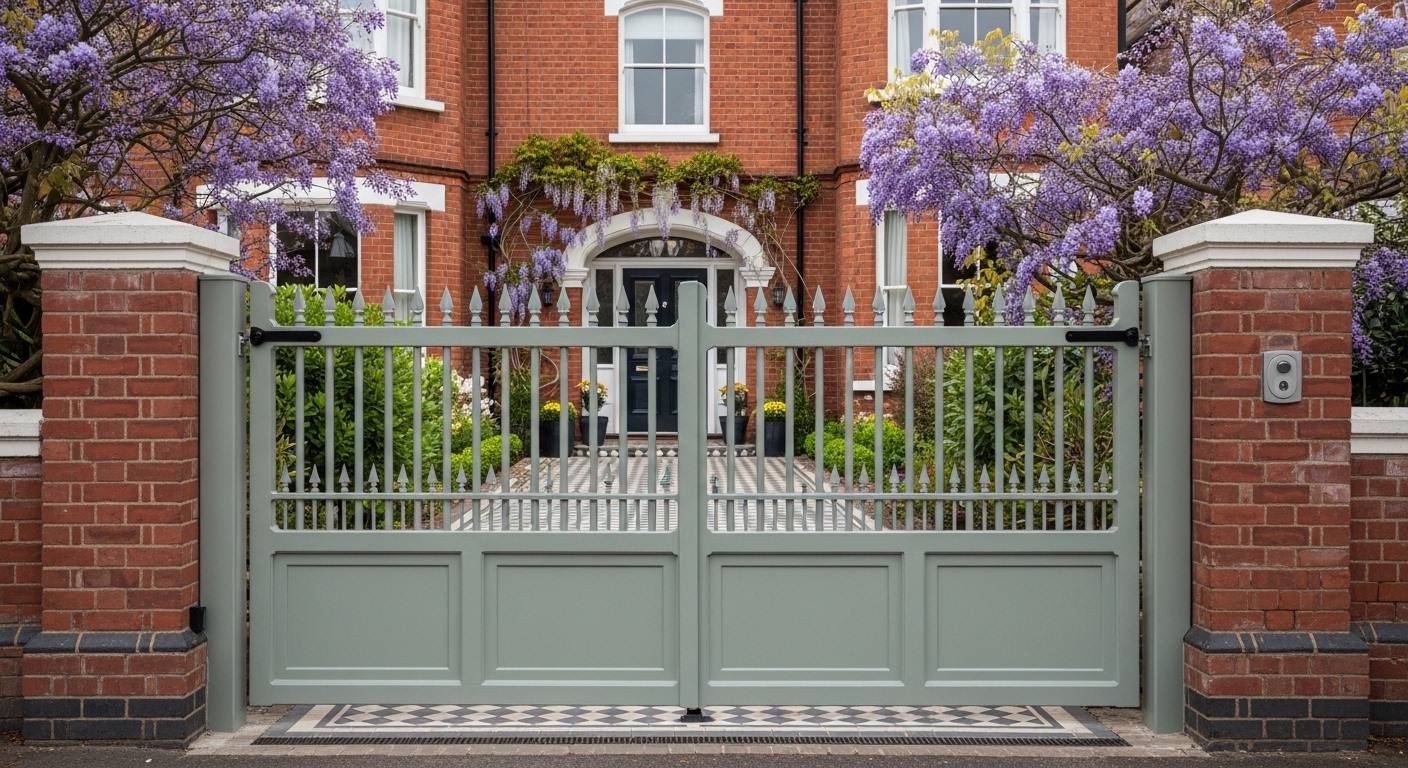
The Victorian and Edwardian houses that line the streets of St Albans, Harpenden, Radlett, and the older parts of St Albans often have existing iron railings at the front boundary. Where these survive, a wrought iron or fabricated steel gate that matches the profile, the rail spacing, and the finial style of the railings is the obvious and usually the correct approach. A good fabricator can take a section of existing railing as a reference and produce a gate that appears to have been made by the same blacksmith.
Where the original railings have been lost, which happened to many Hertfordshire properties during wartime scrap drives, the gate design can reference the period without reproducing a specific historic pattern. Vertical round bars with spear or ball finials, a curved top rail, and a simple scroll detail at the hinge point are all vocabulary elements of Victorian ironwork that work on a new gate without looking like a pastiche. Sage green, black, and dark blue are the period powder coat colours most commonly specified on Hertfordshire conservation area properties.
Hardwood for Rural and Hertfordshire Properties
The period farmhouses, timber-frame farmhouses, and converted agricultural buildings of the Hertfordshire countryside call for hardwood as naturally as the town houses call for iron. European oak is the premium timber choice for this context because its grain character and weathering behaviour match the aged timber already present on most Hertfordshire buildings. Left untreated, oak develops a consistent silver patina over two to three years that harmonises with the building. Oiled, it holds a warm brown tone that works against both ragstone and brick.
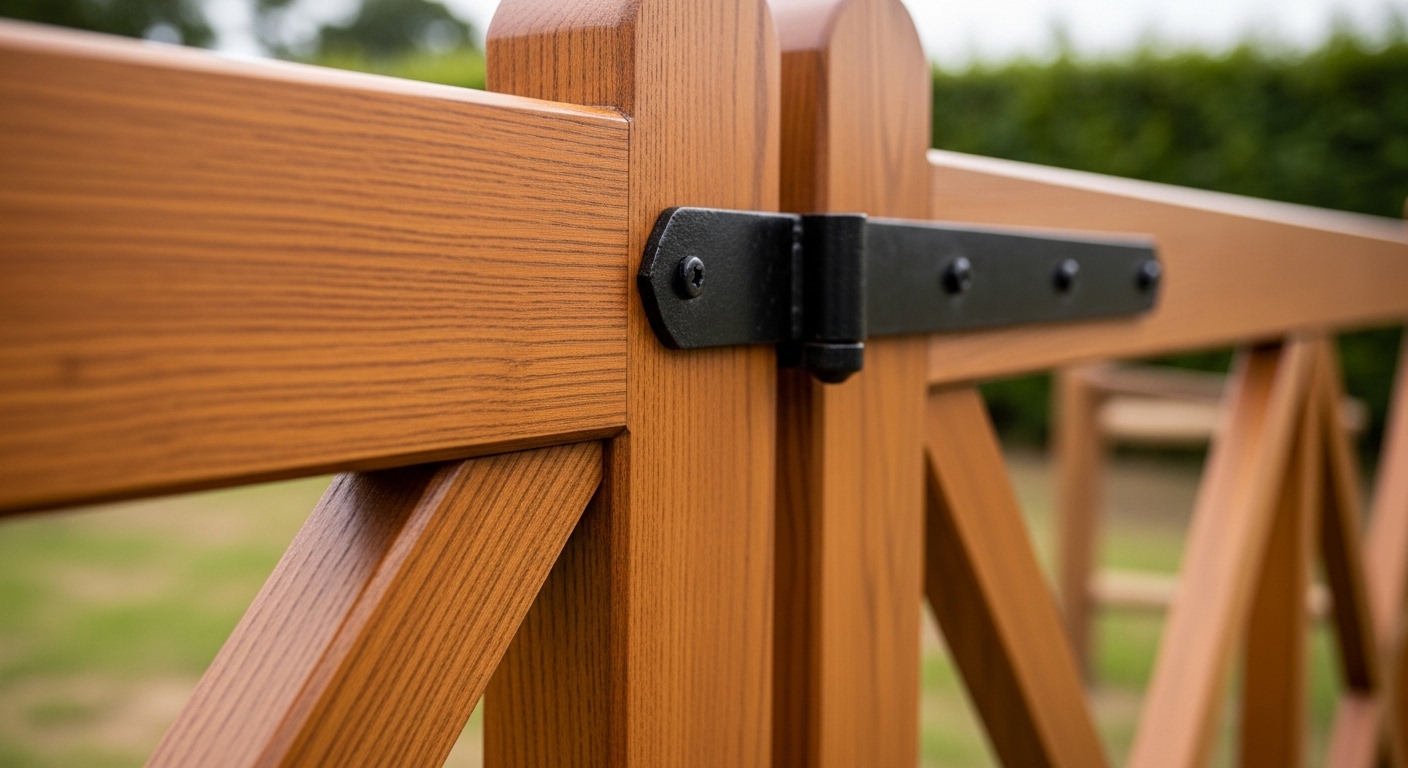
The gate design for a Hertfordshire property should be simple rather than ornate. Close-boarded for privacy, or open-framed with a top rail and vertical boards if the property has an open boundary character. The detailing should be understated. A chamfered edge on the boards, a simple curved top rail, and traditional strap hinges visible on the face of the gate are all sufficient to establish character without overworking the design. Elaborate carving, turned spindles, and decorative cutouts generally look wrong on agricultural conversions and rural farmhouses.
Georgian Properties and the Question of Proportion
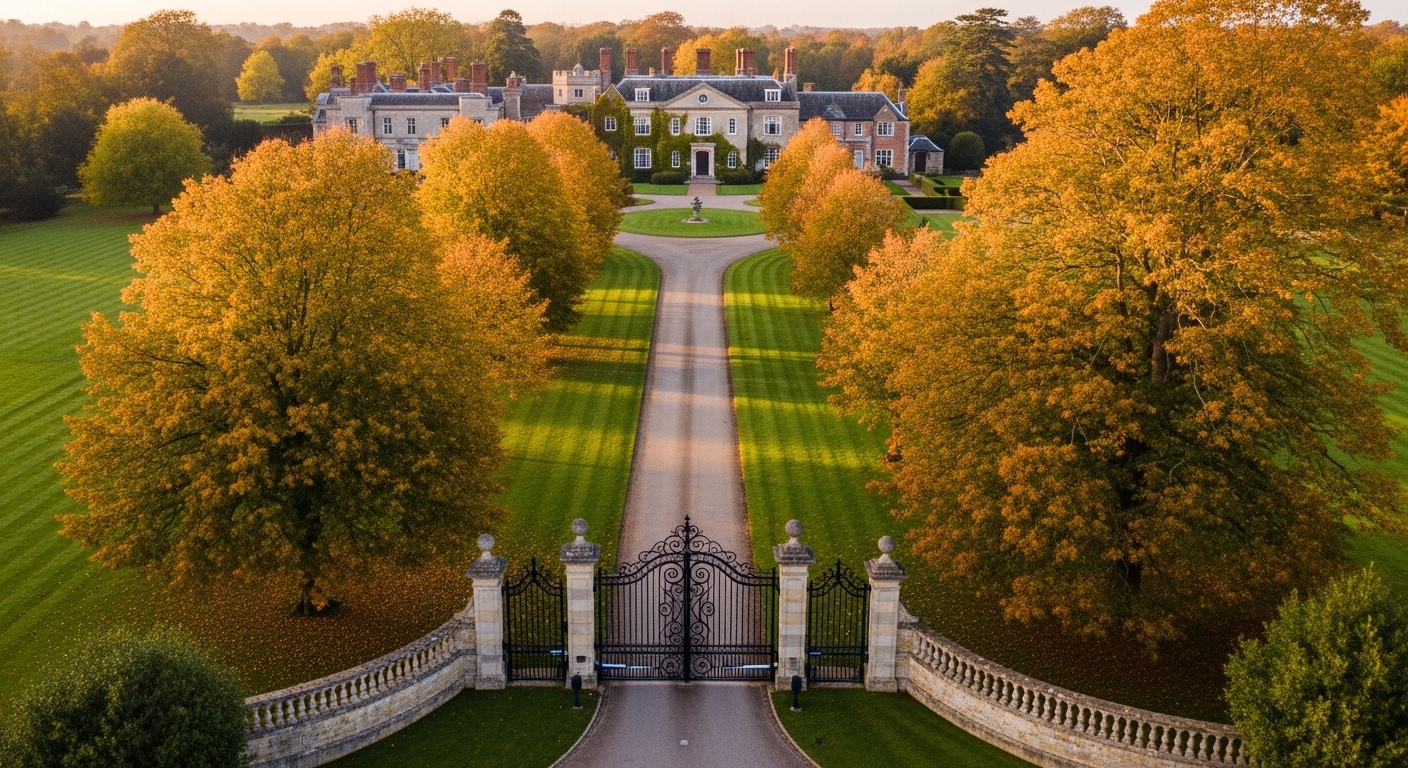
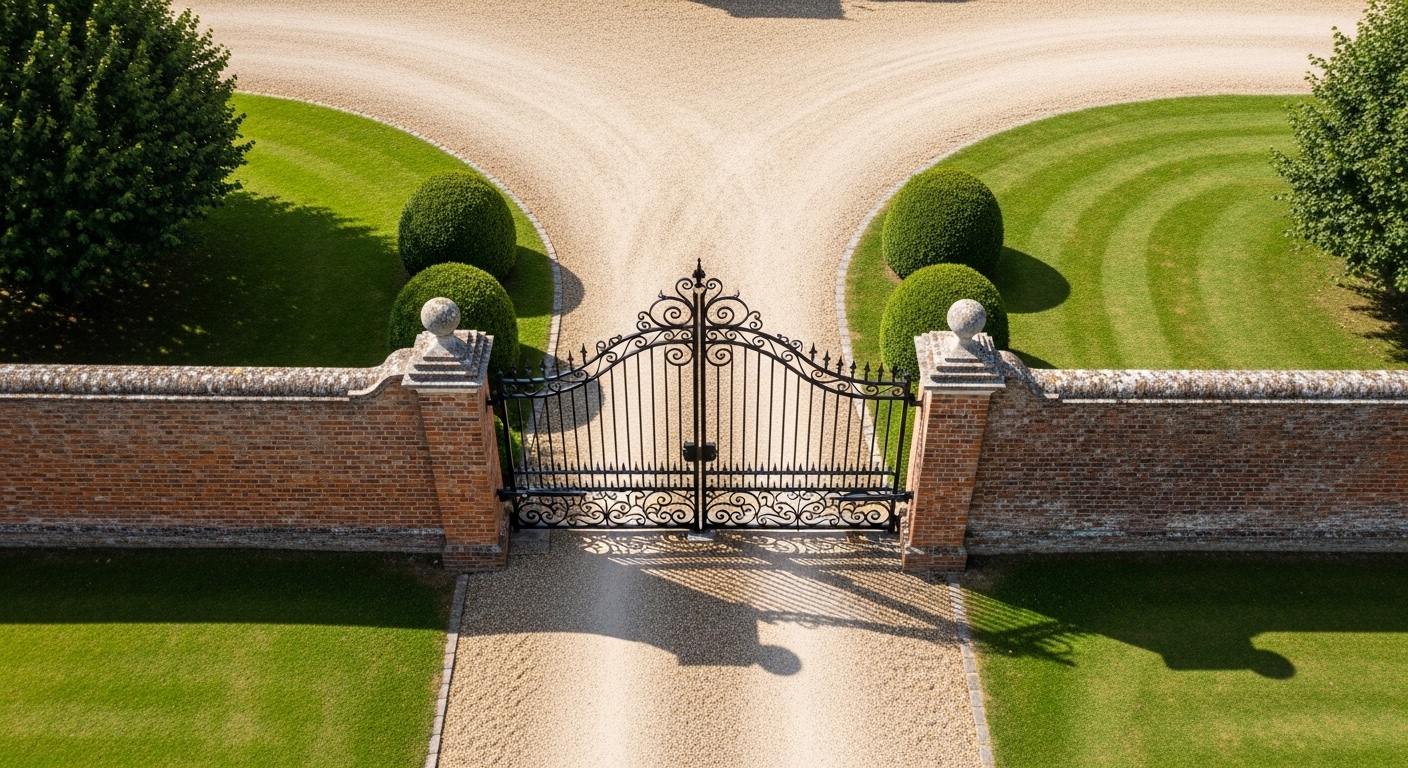
Georgian houses are defined by symmetry and proportion. The gate entrance should respect this. Paired gates of equal width, centred on the driveway, with pillar heights that relate to the window heights and roofline of the house. Georgian ironwork is typically simpler and more restrained than Victorian. Straight vertical bars with minimal decoration, a flat or gently curved top rail, and ball or urn finials rather than ornate scrollwork. The elegance comes from the proportion rather than the detail.
On Georgian properties in Hertfordshire, particularly in the St Albans and Hertford areas where Georgian and Regency architecture is well represented, the pillar specification is as important as the gate itself. Brick pillars with a stone or cast cap, proportioned to the gate height and the boundary wall height, frame the entrance correctly. Thin steel posts or lightweight timber posts undermine the formality that a Georgian entrance requires.
Medieval and Tudor Properties
St Albans and the surrounding villages contain a significant number of medieval and Tudor properties where the boundary treatment is part of the listed curtilage. Listed building consent is required for any gate installation on these properties, and the design must satisfy the conservation officer. Timber is almost always the appropriate material. The style should be robust and simple, reflecting the vernacular building tradition rather than any formal gate design. Thick oak boards, iron strap hinges, and a substantial top rail reference the construction methods of the building itself.
On these properties, the gate is often relatively modest in scale compared to later periods. A 1.2 to 1.5 metre height is common, with the gate sitting within rather than above the boundary wall. Automation needs to be completely invisible. Underground motors or, where the wall structure prevents excavation, a concealed system within the gate leaf or post, are the only acceptable approaches.
Conservation Area Rules in Hertfordshire
St Albans, Hertford, Harpenden, Wheathampstead, St Albans, Harpenden, and dozens of Hertfordshire villages have conservation area designations that affect what you can install at the property boundary. In a conservation area, permitted development rights for gates remain in force, but the local planning authority can impose Article 4 Directions that remove these rights and require a planning application for boundary treatments.
Even where permitted development applies, it is worth designing the gate with the conservation area character in mind. A gate that provokes complaints from neighbours or an enquiry from the conservation officer creates unnecessary stress, even if it turns out to be technically permitted. Matching the material and style to the prevailing boundary character of the street is the simplest way to avoid this. Your installer should be able to advise on what the local character requires based on their experience working in the area.
Automation That Stays Hidden
On period properties, visible automation equipment detracts from the entrance. Underground motors are the standard solution and work on the majority of period property installations where the post foundations can accommodate the chamber. Where underground installation is not possible, ram-arm motors can be positioned on the inside face of the gate and post, invisible from the street. Some installers in our Hertfordshire network have experience with concealed motor systems built into the gate leaf itself, though these are specialist installations.
Access control hardware should also be discreet. A video intercom panel can be flush-mounted into a brick pillar or wall rather than surface-mounted on a visible bracket. Proximity readers can be concealed within the post cap. Keypads should be finished in a colour that matches the pillar material rather than left in standard white or silver plastic. Every detail that keeps the technology invisible improves the overall presentation of the entrance.
Getting Professional Design Input
The best gate installations on period Hertfordshire properties involve a design conversation between the homeowner, the installer, and in some cases the fabricator or joinery workshop. Drawings produced before fabrication allow you to see and adjust the design before any material is cut or metal is bent. On larger projects, 3D renders showing the gate in position against the existing building are standard practice and worth requesting.
Submit your enquiry and we will match you with Hertfordshire gate specialists who have demonstrable experience with period properties, conservation areas, and listed buildings. Each one will visit the property, discuss the design brief, and produce drawings and a quote tailored to your specific entrance.